Mold-Free, Worry-Free: Safer, Low VOC Bath Refinishing for Hospitals and Schools
Ventilation & Containment Systems
What gun cleaning solutions protect seals?
Professional HVLP spray systems with appropriate nozzle sizes can atomize thicker refinishing coatings effectively.
Not all cleaning solutions are safe for spray gun components.
Choose cleaning solutions that:
- Do not degrade seals
- Do not corrode internal passages
- Remove coating residue effectively
- Use nylon brushes and Zen-Strip Liquid for monthly thorough cleanings.
Regular maintenance prevents costly equipment replacement.
There's a version of the refinishing conversation that every contractor who works commercial accounts eventually runs into. The facilities director at a hospital or a school district's maintenance supervisor calls wanting to know about resurfacing the tubs, sinks, and shower surrounds across multiple buildings. It's exactly the kind of volume work that can anchor a refinishing business. Then comes the question: "What are you spraying in there, and is it safe for an occupied building?"
If your answer depends on solvent-borne coatings and a request to evacuate the wing for 24 hours, that conversation often ends right there. Healthcare facilities can't do that. Schools won't. And the demand for low-VOC, low-odor refinishing systems in institutional settings has grown well past the point where contractors can afford to treat it as a niche request.
This post covers what professional refinishers need to know about water-based coating systems for healthcare, education, and other safety-conscious environments — what the products can actually do, how they compare to conventional solvent-based systems, and how to run a water-based job correctly.
Why Healthcare and Schools Present Different Refinishing Demands
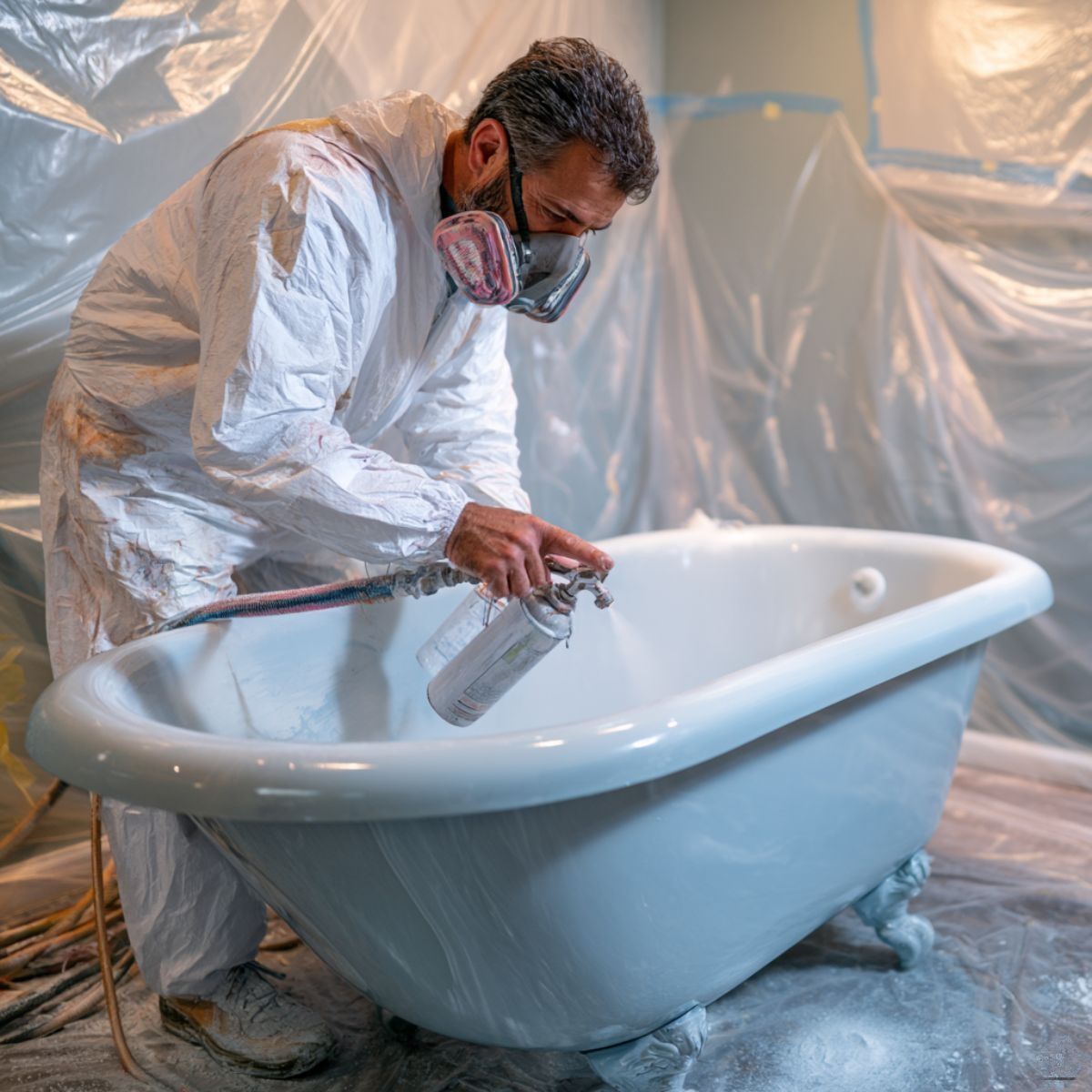
Painters working on open walls have room to breathe. Refinishers don't. Bathtubs, shower stalls, tile walls, countertops, and cabinet faces are almost always surrounded by surfaces that can't get coated — glass, chrome, grout, flooring, cabinetry, mirrors. The work zone is tight, the coating is fast-moving in aerosol form, and the surfaces around you are often glossy enough that even light overspray shows up immediately.
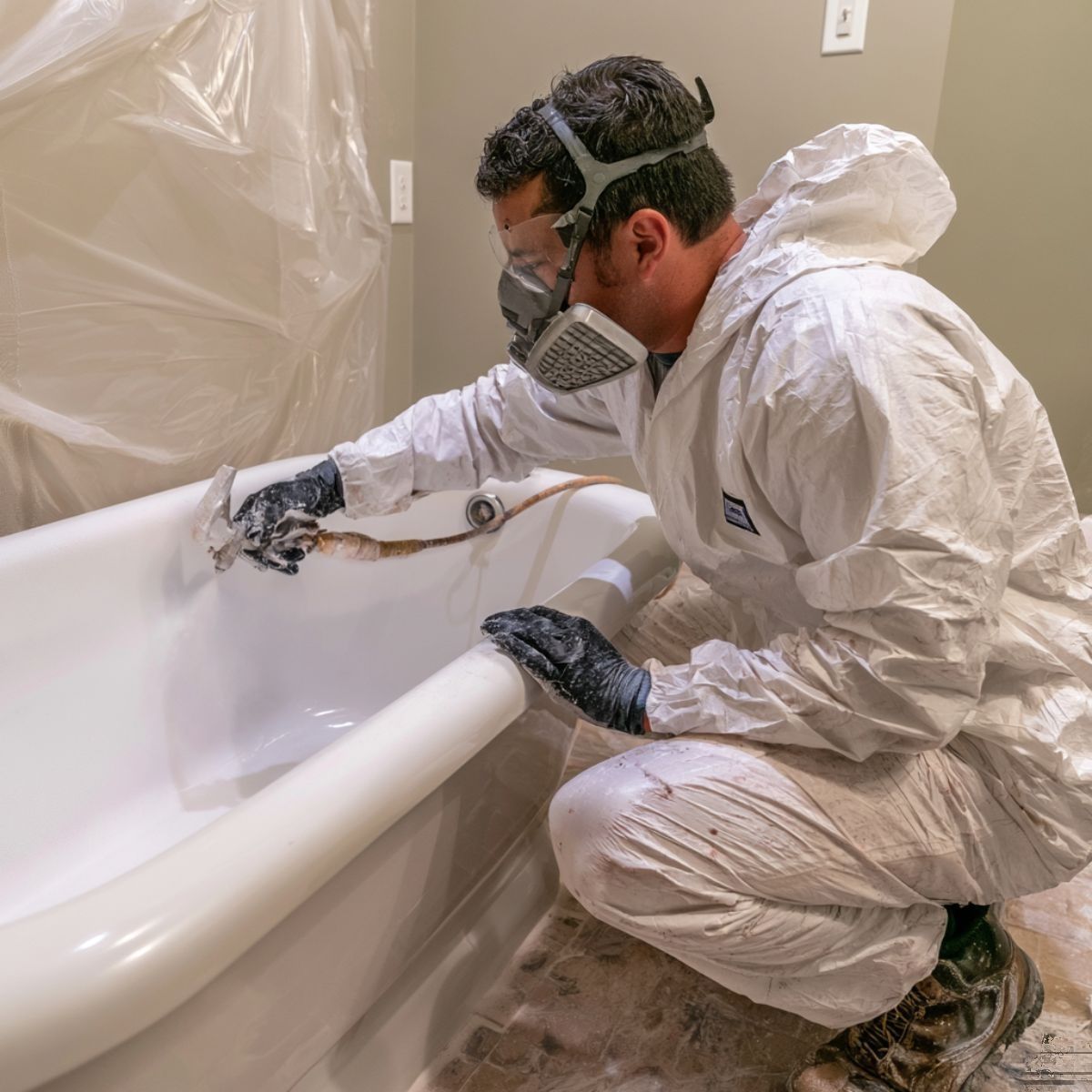
Add to that the fact that professional refinishing coatings are engineered to bond aggressively and cure hard. That's what makes them durable on the surfaces you're refinishing. It's also what makes overspray on the wrong surface a real problem to remove once it cures. Getting your masking right before you spray isn't a necessity — it protects the quality of your work and your reputation with the client.
The Problem With Legacy Water-Based Coatings
Water-based refinishing products aren't new. Contractors have had access to them for years, and the reputation many of them earned was not good. Early water-based topcoats struggled with adhesion to non-porous substrates like porcelain, acrylic, and fiberglass. They were prone to orange peel and dry spray when conditions weren't perfect. They leveled poorly compared to solvent-borne systems, and the finish often looked flat or milky next to a conventional urethane — a problem that's hard to explain to a client who's comparing your work to the tub you refinished next door six months ago.
That reputation has created real resistance in the trade. Experienced refinishers who tried water-based products a decade ago and were disappointed have understandably been reluctant to go back. The concern is legitimate. But the formulations have changed significantly, and not all water-based systems are the same.
The difference between a poorly engineered water-based coating and a properly formulated professional-grade system is significant — in adhesion, gloss, leveling behavior, durability, and dry time. If your experience with water-based coatings predates current formulations, the products available today are worth a second look.
Zen-Tek's Water-Based System: Built for Real Refinishing Work
Every refinishing job starts with adhesion, and water-based primers have historically been the weakest link in low-VOC systems. WTR-Prime, Zen-Tek's water-based epoxy primer, was built specifically to solve that problem.
It's a two-component water-based primer formulated for the substrates refinishing contractors work on every day — porcelain, fiberglass, acrylic, ceramic tile, cast iron, and laminate. No reducer is needed, which simplifies the system and removes a variable that causes adhesion inconsistencies with some competing products. The formula bonds aggressively to non-porous surfaces, which is the exact scenario where other water-based primers have historically underperformed.
Dry time is a real consideration with any water-based primer. WTR-Prime needs at least 30 minutes between primer coats, approximately one hour before topcoat application, and 30 to 45 minutes between topcoat passes. That's longer than a solvent-based system, and job planning needs to account for it. What you get in return is a product with superior adhesion to the competition, low odor that forces room evacuation, and a clean compliance story for any facility that asks what you used.
WTR-Tek: The High-Gloss Water-Based Topcoat That Changed the Expectation
The topcoat is where water-based systems have most often let contractors down — and where WTR-Tek separates itself from the field.
Most refinishers who've worked with water-based topcoats have had the experience of looking at a finished surface and thinking it looks close, but not quite right. The gloss isn't quite there. The leveling is almost smooth, but not the mirror quality you'd expect from a solvent-borne urethane. WTR-Tek was developed to close that gap. The formulation produces a high-gloss finish with leveling characteristics that compete with conventional solvent-based systems — not as a compromise, but as a genuine performance outcome.
Additional benefits that matter in a commercial context:
- High gloss rating that holds up to institutional cleaning protocols
- Superior finish quality — smoother, more uniform, and visually on par with solvent-based results
- Higher durability than other water-based products, which matters in high-traffic institutional settings where surfaces take regular cleaning abuse
- More affordable than many comparable water-based systems, which helps the economics on large-volume accounts
- Excellent compatibility with multicolor and texture systems — WTR-Tek works well for specialty texture finishes, expanding the range of services you can offer
- Recoat in as little as 30 minutes, which keeps multi-coat jobs moving at a pace that's practical for commercial work
The product applies by spray or roller without requiring water or additives, which simplifies the system and reduces variables in the field. HVLP spray equipment works with WTR-Tek without modification — no new gear required for contractors transitioning from solvent-based systems.
The Anti-Microbial Additive: The Layer Healthcare Clients Actually Need
VOC compliance and odor control get the door open with healthcare and school clients. The anti-microbial coating additive is what closes the deal.
Zen-Tek's anti-microbial additive integrates directly into your topcoat — no separate application step, no compatibility concerns. It creates a mold and mildew-resistant barrier in the cured coating film itself, which is where the protection needs to live in a bathroom environment that sees daily moisture and disinfectant cleaning.
For a hospital bathroom or a school locker room shower, this isn't an upsell. It's a legitimate answer to an infection control requirement that facility managers take seriously. Being able to document that the refinishing system includes an integrated antimicrobial layer — not just a surface spray applied on top — gives the facilities team something concrete to put in front of their infection control committee.
The additive works with both the WTR-Tek water-based topcoat and Zen-Tek's solvent-based systems, giving you flexibility depending on the client's requirements and the specific facility constraints.
How the Water-Based System Compares to Conventional Refinishing Coatings
Contractors evaluating a water-based system for the first time are usually asking three questions: Does it look as good? Does it last as long? And does it make my job harder?
Appearance: With WTR-Tek, the gloss and leveling quality are genuinely competitive with solvent-based urethanes. This isn't true of all water-based coatings, but it's true of this one. The key is technique — water-based coatings flash differently than solvent-borne products, and spray settings need to be adjusted to match. More on that below.
Durability: WTR-Tek is formulated for institutional use, which means it's designed to hold up to the cleaning chemical exposure and surface traffic that healthcare and school facilities produce. The durability profile is stronger than most water-based coatings in the category.
Application difficulty: Water-based products are more sensitive to temperature and humidity than solvent-based systems, and they don't forgive technique errors the same way a well-leveling urethane does. Contractors who take the time to understand the product's behavior — proper gun pressure, appropriate environmental conditions, correct dry times — get excellent results. Those who try to apply a water-based topcoat exactly like a solvent-borne system will struggle.
VOC and odor: This is where water-based systems win unconditionally. The ability to refinish in an occupied or semi-occupied building, meet indoor air quality requirements, and hand the space back to the client without a prolonged off-gassing period is a real operational advantage — and in healthcare and school environments, it's often the only path to getting the job.
Running a Water-Based Refinishing Job Correctly
Understanding the system matters as much as choosing the right products. A few principles that apply specifically to water-based refinishing work:
Surface prep doesn't change. Water-based topcoats require the same substrate preparation as solvent-borne systems. Clean surfaces, proper etching or mechanical scuffing, and solid primer adhesion are prerequisites regardless of what goes on top. Skipping prep because the topcoat is "safer" is how callbacks happen.
Environmental conditions matter more. Water-based coatings are more sensitive to temperature and relative humidity during application and cure. Cold temperatures slow cure significantly; high humidity can cause surface defects. Know your environment before you start and check conditions during application.
Spray equipment works as-is, but settings need adjustment. HVLP equipment used for solvent-based refinishing will work with WTR-Tek. The fluid pressure and fan settings may need to be dialed down from your solvent-based baseline. Water-based coatings atomize differently — too much pressure produces dry spray and texture; too little causes runs. Dial in on a test surface before you start the job.
Cleanup is straightforward. Water-based systems clean up with water while uncured. This is a legitimate time and cost advantage on multi-day or multi-room jobs. Gun cleaning is faster and doesn't require solvent disposal.
Respect the dry times. The extended dry times between WTR-Prime coats and between topcoat passes aren't suggestions — they're functional requirements for adhesion and film integrity. Rushing this step is the most common cause of water-based refinishing failures.
The Business Case for Offering a Water-Based System
Beyond the technical performance of the products, there's a straightforward business argument for any refinishing contractor who works or wants to work in commercial settings.
Healthcare facilities, school districts, assisted living communities, hotels with VOC restrictions, and residential clients with chemical sensitivities represent a segment of the market that conventional solvent-based refinishing systems simply cannot serve. That's not a small segment — it's growing, and the regulatory trends around indoor VOC limits are not moving in the direction of loosening restrictions.
Contractors who can offer a fully water-based system — low-VOC primer, high-performance topcoat, and an integrated antimicrobial option — have access to accounts that competitors running conventional systems can't touch. That's a real competitive position, and it's one that becomes more valuable as institutional procurement teams become more sophisticated about what they're requiring from service vendors.
The system is there. The products perform. The business case for having this capability in your service offering is straightforward.
Frequently Asked Questions About Water-Based and Low-VOC Refinishing Coatings
Is water-based coating durable enough for tubs, showers, and sinks compared to solvent or epoxy systems?
Yes — provided the product is engineered for professional refinishing applications. Consumer-grade water-based coatings are not the same as products built for commercial refinishing work. WTR-Tek is a two-component water-based polyurethane formulated specifically for the high-moisture, high-cleaning-chemical environment of institutional and residential bathrooms. Its durability profile exceeds most water-based alternatives in the category. Adhesion, gloss retention, and chemical resistance all meet the demands of real-world use.
Will a water-based coating properly adhere to slick surfaces like porcelain, fiberglass, or acrylic?
With the right primer and surface prep, yes. Adhesion to non-porous substrates is the area where lower-quality water-based products have historically failed, and where WTR-Prime distinguishes itself. It's a two-component water-based epoxy primer formulated specifically for porcelain, fiberglass, acrylic, ceramic, cast iron, and laminate. Proper surface preparation — cleaning, etching with a product like AdvanEtch, or mechanical scuffing — is still required regardless of the primer used. The primer bonds to what the prep creates; it doesn't compensate for a substrate that wasn't properly prepared.
How does curing and dry time work with low-VOC or water-based coatings?
Does a water-based coating resist mold, mildew, and cleaning chemicals used in bathrooms?
WTR-Tek is formulated to resist the chemical exposure that institutional bathrooms produce, including the disinfectants and cleaning agents used in healthcare and school settings. For projects where mold and mildew resistance is a formal requirement — or where the client is specifically requesting antimicrobial protection — Zen-Tek's anti-microbial additive integrates directly into the topcoat, creating a mold and mildew-resistant barrier within the cured film itself.
Does it level and spray as smoothly as solvent-based coatings, without orange peel or dry spray?
WTR-Tek levels and sprays better than any other water-based refinishing topcoat currently on the market. That said, water-based coatings are more technique-sensitive than solvent-borne systems. Gun pressure needs to be set appropriately for a water-based product — too high causes dry spray and texture; too low causes runs. Application temperature and humidity affect leveling. Contractors who dial in their settings for the specific product and environment will get a smooth, high-gloss finish that stands up to solvent-based systems visually. Contractors who try to apply a water-based topcoat exactly like a urethane without adjusting will see quality differences.
Can I use my existing HVLP or turbine equipment with water-based products, or do I need new gear?
Your existing HVLP equipment works with WTR-Tek. No new gear is required. You will need to adjust your pressure and fan settings — water-based coatings atomize differently than solvent-borne products, so settings that work for urethane will need to be dialed back. Beyond that, the main equipment consideration is cleaning: water-based systems clean up with water while uncured, which is faster than solvent cleanup but requires that guns be flushed promptly after use before the material begins to cure in the lines.
What prep is required — does it still need acid etch, scuff sanding, or bonding primer?
Full surface preparation is required regardless of whether you're using a water-based or solvent-based system. The topcoat chemistry doesn't change what the substrate needs to receive it well. Clean the surface thoroughly to remove soap scum, oils, and residue. Etch with a product like
AdvanEtch or mechanically scuff to create a profile for the primer to bond to. Apply WTR-Prime as the bonding layer. Shortcuts in prep are the primary cause of adhesion failures with any refinishing system, water-based or otherwise.
Is the odor low enough to use in occupied homes, apartments, schools, or hospitals?
WTR-Prime and WTR-Tek are specifically formulated to be low-odor and low-VOC, which makes them suitable for use in occupied or semi-occupied buildings where solvent-based products would require evacuation. Healthcare facilities, schools, and occupied apartment buildings are the environments these products were designed for. The odor profile is substantially lower than solvent-borne systems, though adequate ventilation during application is still good practice. The key advantage for institutional clients is that the space can be returned to use without the extended airing-out period that conventional urethanes require.
Are water-based bath coatings compatible with high-moisture areas like shower surrounds?
Yes. WTR-Tek is engineered for bathroom environments, including shower surrounds and other areas with continuous moisture exposure. Proper surface prep and primer adhesion are the foundation of long-term water resistance — the topcoat chemistry handles ongoing moisture exposure well when the system is applied correctly.
Can I offer a warranty or guarantee with water-based coatings, and will clients accept it?
Water-based coatings applied as a complete, properly prepared system support the same warranty structure as solvent-based refinishing work. The durability of the system is what backs the warranty, not the coating type. With WTR-Tek and WTR-Prime used together with appropriate prep, the bond and finish quality are strong enough to stand behind with standard refinishing guarantees. In institutional settings, offering a documented warranty is often part of what's required to win the contract, and being able to provide it with a fully water-based system is an advantage.
Do water-based coatings yellow over time or remain color-stable?
Water-based polyurethane coatings have better UV stability and color retention than many solvent-borne urethane systems, which are prone to yellowing in low-light environments. WTR-Tek maintains color stability over time, which matters for institutional clients who need surfaces to look presentable for years between refinishing cycles.
Can I do chip or scratch repairs on water-based coatings using the same methods?
Spot repairs on WTR-Tek follow a similar process to solvent-based systems — clean the damaged area, re-prime if necessary, apply topcoat to blend. The challenge with any refinishing repair is feathering the new coat into the existing finish seamlessly, and that skill applies regardless of the coating type. Use the same WTR-Tek system for repairs as for the original application.
What is the cleanup like — water rinse only, or do I still need solvents?
Cleanup while the material is uncured is water only — gun, lines, and tips flush with water, which is faster and simpler than solvent-based cleanup and eliminates the cost and disposal requirements associated with solvent-based flushing. Once the material has begun to cure, water alone won't remove it. The practical takeaway: flush your equipment promptly at the end of every job and between uses. Don't let mixed material sit in your gun.
Do manufacturers provide performance data or long-term testing results for water-based systems?
Zen-Tek provides technical data sheets for both WTR-Tek and WTR-Prime that document adhesion, gloss ratings, dry times, and application specifications. For institutional clients who require documentation for procurement or compliance purposes, these data sheets provide the formal performance record needed to support the specification.
Is a water-based system more realistic for bathrooms in healthcare or education facilities due to VOC and odor codes?
In many cases, yes — it's not just more realistic, it may be the only option. Healthcare facilities and many school districts operate under indoor air quality protocols and VOC restrictions that effectively prohibit solvent-based refinishing in occupied or semi-occupied buildings. WTR-Prime and WTR-Tek are designed to meet those restrictions, which means contractors using this system can access institutional accounts that are simply off-limits to conventional solvent-borne refinishing operations.
How do I apply water-based refinishing coatings without getting brush marks, runs, or dry spray?
Spray application is the standard for professional refinishing work, and WTR-Tek is designed for HVLP spray. The keys to a smooth finish are correct gun pressure (adjusted down from solvent-based baseline settings), appropriate environmental conditions (temperature above 60°F, relative humidity in the mid range), and a consistent, controlled spray motion. Dry spray results from too much pressure or too much distance from the surface; runs result from too little pressure or too slow a pass. Dial in on a test surface before the job and check conditions during application.
How do I adjust my spray technique when switching from solvent-based to water-based coatings?
The fundamental motion — overlapping passes, consistent gun speed, appropriate distance from the surface — is the same. What changes is the pressure setting. Water-based coatings atomize at lower pressures than solvent-borne systems. Start with your fluid pressure lower than your solvent-based baseline and adjust from there. Water-based products also flash differently — they don't evaporate as quickly — so move at a slightly faster pace than you might with a conventional urethane to avoid buildup.
How do I prevent flashing or uneven sheen when spraying water-based products on large tile walls or tubs?
Consistent application speed, overlap, and pressure across the entire surface are the main controls for uneven sheen. On large vertical surfaces, work in horizontal passes from top to bottom with consistent overlap. Avoid stopping mid-surface — if you need to stop, stop at a natural break like a grout line or edge rather than in the middle of a tile field. Adequate ventilation helps prevent localized flashing where one area dries faster than another.
How do I determine if a bonding agent is still needed with a water-based system?
WTR-Prime serves as the bonding primer in Zen-Tek's water-based system and is designed to be the adhesion layer between the prepared substrate and the topcoat. On properly prepared surfaces — cleaned, etched, or scuffed — WTR-Prime provides the bond strength needed without an additional bonding agent. If you're working on a substrate with adhesion challenges (previous coatings that weren't fully removed, unusual surface contamination), consult the technical data sheet and consider whether additional prep steps are warranted before priming.
WTR Prime can work with bonding agents even non water based. BUT the surface needs to be dry before applying the primer, especially while using solvent based adhesion promoters
How do I clean and degrease tubs and tile before using a water-based topcoat?
The degreasing process is the same as for solvent-based systems — thorough removal of soap scum, oils, silicone residue, and any other contamination that would compromise adhesion. A proper cleaning agent followed by a clean-water rinse, allowed to dry completely before etching or scuffing, is the standard sequence. Water-based systems don't tolerate surface contamination any better than solvent-borne systems — in some respects they're more sensitive to it, since the chemistry that drives adhesion is different.
How do I reduce dry spray or grainy texture when spraying water-based coatings in low humidity?
Low humidity accelerates solvent flash-off with any coating, but water-based products can be particularly sensitive because the water carrier evaporates faster in dry conditions. In low-humidity environments, reduce your gun-to-surface distance slightly, keep fluid pressure on the lower end of the appropriate range, and work in sections that allow you to maintain a wet edge. If conditions are very dry, morning application hours typically offer better humidity levels than midday in arid environments.
How do I level water-based coatings for a smooth, glossy finish like solvent-based systems?
WTR-Tek has good self-leveling characteristics, but it needs appropriate conditions to develop them. Correct fluid pressure, adequate film build (not too thin), and environmental conditions within the recommended range all contribute to leveling. A coating applied too thin will show texture; a coating applied too thick in humid conditions can develop surface defects. Apply in consistent passes that build adequate film thickness, and let the product's leveling chemistry do the work.
How do I properly mask and ventilate a space when using water-based refinishing coatings indoors?
Masking for a water-based job is the same as for any refinishing project — protect all surfaces adjacent to the work zone. The ventilation requirement is lower than for solvent-based systems, but airflow during application is still important for finish quality and to remove atomized particles from the work area. A box fan exhausting air toward a window or door is typically adequate for most bathroom refinishing work with water-based coatings.
How do I recoat or do a second pass with water-based finishes — what's the wait time?
Between WTR-Tek topcoat passes, 30 to 45 minutes of dry time is required. The surface should be dry to the touch and firm before the next coat goes on — not tacky, not visibly wet. In cooler or more humid conditions, wait toward the longer end of that range. Applying the next coat too soon traps solvents and can cause adhesion problems between coats.
How do I clean my spray equipment after applying water-based refinishing coatings?
Flush guns, lines, and tips with clean water immediately after use, while the material is still uncured. Run water through until it comes out clear. The two-component nature of WTR-Tek means the mixed material has a finite pot life — material left in the gun begins to cure and will eventually block the tip and lines if not flushed. Don't let mixed material sit. Immediate cleanup with water is straightforward; deferred cleanup may require solvent and mechanical clearing.
How do I blend water-based spot repairs into previously refinished surfaces?
Clean the repair area thoroughly, feather the edges of the damaged coating lightly, reprime with WTR-Prime if the substrate is exposed, then apply WTR-Tek in thin passes that blend toward the surrounding finish. The challenge with any spot repair — water-based or solvent-borne — is matching the sheen of a cured coating with fresh material. Feathering the edges of the repair and allowing the finish to level naturally gives the best blend.
How do I get good edge coverage without overspray when using water-based coatings?
Edge coverage technique is the same as with any spray application — start your gun stroke before the edge, maintain consistent speed and pressure through the pass, and end after the edge. Don't trigger on or off at the edge of the surface. For tight edge situations, a slightly tighter fan pattern and lower pressure give you more control. Adequate masking of the adjacent surfaces handles whatever overspray does occur.
How do I fix peeling or soft spots if a water-based coating didn't cure properly?
Peeling and soft spots in a water-based coating almost always trace back to either insufficient dry time between coats, application in conditions outside the recommended temperature and humidity range, or surface contamination that prevented adhesion. For repairs, remove the affected coating, clean and prepare the substrate correctly, and reapply the system from primer up. Spot-applying topcoat over an adhesion failure won't hold.
How do I know if the surface is fully dry and ready for use after using a low-VOC topcoat?
A surface that's cured to service-ready hardness should feel firm and smooth to the touch, with no tackiness. WTR-Tek reaches a usable state faster than solvent-based systems from an odor and air quality standpoint, but full hardness development takes additional time. Follow the technical data sheet guidance for return-to-service timing. In institutional settings, communicate the return-to-service timeline clearly to the facility team so the space isn't put back into use before the coating has developed adequate hardness.
How do I spray water-based refinishing coatings on vertical surfaces like shower tile or tub surrounds?
Vertical surfaces require attention to film build and run prevention. Apply in horizontal passes with moderate fluid pressure and consistent gun speed — too slow or too heavy builds too much material in one pass and causes runs on vertical surfaces. Apply multiple thin passes rather than one heavy coat. Water-based coatings don't have the same run-resistance as thicker solvent-borne systems, so controlled application is more important.
How do I prevent water-based coatings from running or sagging on curved or sloped tub walls?
Keep fluid pressure at the lower end of the appropriate range and use thinner passes on curved geometry where material can pool in concave areas. On sloped tub walls, work from the bottom up so any overspray from the pass above lands on unsprayed surface rather than on a coat that's already been applied. Watch for material accumulation at curves and edges — if you see it building, move on and come back for a final light pass rather than trying to even it out while it's wet.